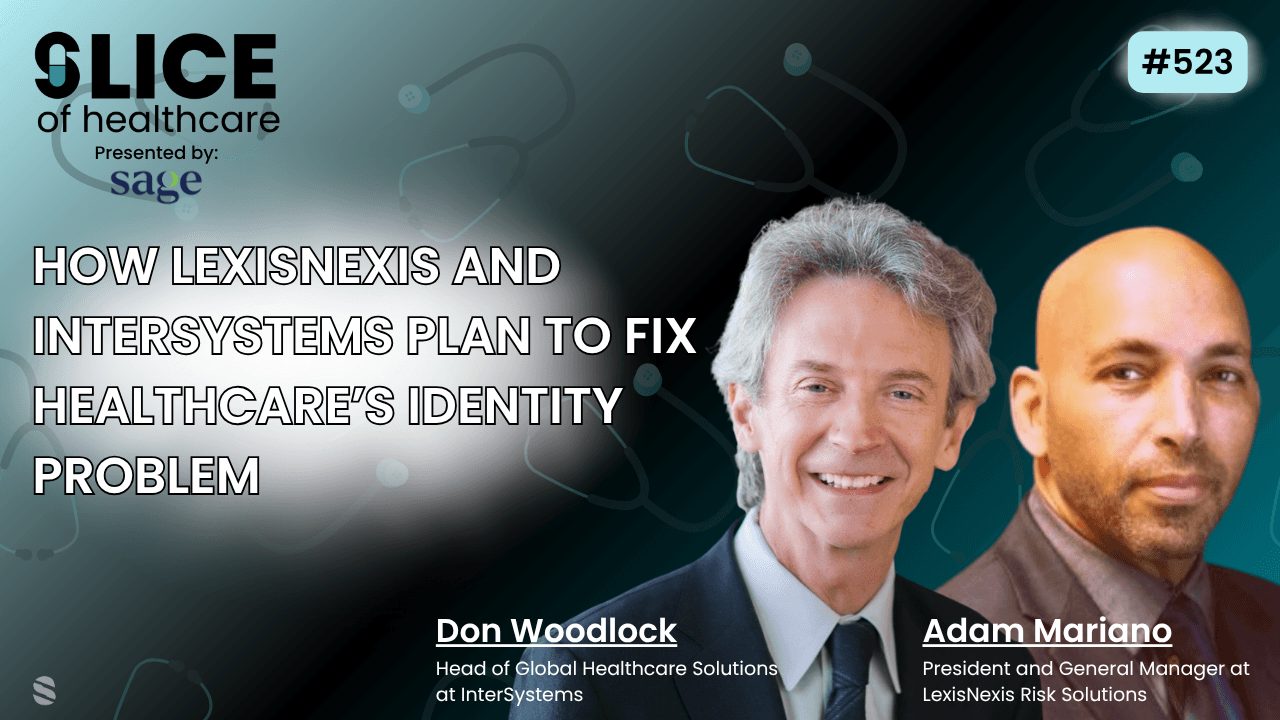
#523 - Adam Mariano, President and General Manager at LexisNexis Risk Solutions & Don Woodlock, Head of Global Healthcare Solutions at InterSystems

Slice of Healthcare Team
10/15/2025


Guests

Connect via:
Don Woodlock is Head of Global Healthcare Solutions at InterSystems, where he leads the company’s healthcare vision and strategy, including its HealthShare and TrakCare businesses. With over 30 years of experience in healthcare technology, he has built customer-focused software for payers, health systems, and public health agencies. Don is a recognized voice on innovation, healthy data, and the responsible adoption of AI and machine learning in healthcare, regularly sharing insights through his Code to Care series and keynote presentations.
Episode details
Join us on the latest episode, hosted by Jared S. Taylor!
Our Guests: Adam Mariano, President and General Manager at LexisNexis Risk Solutions & Don Woodlock, Head of Global Healthcare Solutions at InterSystems.
What you’ll get out of this episode:
- Why data fragmentation persists despite a decade of digital transformation in healthcare.
- Stakeholder-specific challenges from payers to providers, and how fragmentation impacts each differently.
- The human cost of incomplete records, from patient frustration to dangerous outcomes.
- What an identity-first strategy looks like, and why it’s crucial for resolving fragmentation.
- How LexisNexis and InterSystems partner to unify healthcare data with innovative identity resolution.
Watch
Listen
Read More
A Persistent Problem in a Digitized System
Despite billions poured into digital transformation since 2012, healthcare still struggles with data fragmentation. As Don Woodlock of InterSystems explains, the healthcare system’s inherent complexity, privacy concerns, and local fragmentation across providers, payers, and life sciences companies hinder interoperability. Adam Mariano from LexisNexis Risk Solutions adds that the industry’s late shift to digital—only mandated in the last decade—means foundational systems like EMRs were originally built for billing, not care delivery, creating lasting gaps in data alignment.
How Fragmentation Impacts Stakeholders Differently
From Adam’s perspective, each stakeholder—whether provider, payer, or life sciences—operates with different incentives and incompatible data languages. This creates obstacles not just in sharing information but in aligning on care delivery. Don emphasizes that clinicians often operate with incomplete patient views, leading to misinformed decisions. Patients, too, suffer: they’re repeatedly asked for the same information, which decreases compliance and increases care inequity. Fragmented records don’t just slow down workflows—they put lives at risk.
The Real-World Risks of Incomplete Records
The conversation takes a personal turn when host Jared Taylor shares his own healthcare experience after a sports injury. The lack of integrated records between ER visits and urgent care highlighted how dangerous fragmented data can be. Adam and Don agree: for elderly patients or those with complex conditions, not having a full medical record readily available can lead to errors, contraindicated treatments, and overall decreased quality of care.
Why an Identity-First Strategy Matters Now
Don defines an identity-first strategy as the foundation for solving data fragmentation: before you can unify data, you must accurately match it to the correct patient. But this is no easy feat. With patients often having multiple records across providers and locations, traditional demographic matching falls short. That’s where technology from LexisNexis comes in, helping InterSystems enhance their master patient index with more accurate, referential data. Adam explains how this strategy extends beyond identity resolution to include demographic and behavioral enrichment, enabling healthcare organizations to engage individuals more effectively.
From Fragmented to Connected: A Strategic Partnership
Together, InterSystems and LexisNexis Risk Solutions are tackling fragmentation head-on. InterSystems integrates data across platforms, while LexisNexis contributes advanced identity resolution and enrichment capabilities. By combining their strengths, the two organizations help healthcare systems, payers, and digital health innovators move from siloed, error-prone environments to connected, data-informed ecosystems that support better care outcomes.