Fixing Healthcare’s Identity Crisis, One Record at a Time

Slice of Healthcare Team
11/19/2025


Introduction
In a system where lives hinge on information, healthcare still can’t keep its facts straight. Two industry veterans explain why and how they’re fixing it.
What They Do (Plainly Put)
LexisNexis Risk Solutions and InterSystems are teaming up to solve one of healthcare’s most stubborn problems: data fragmentation. Their partnership combines high-fidelity identity resolution (from LexisNexis) with healthcare data interoperability infrastructure (from InterSystems) to help organizations connect patient records accurately across fragmented systems.
How It All Started
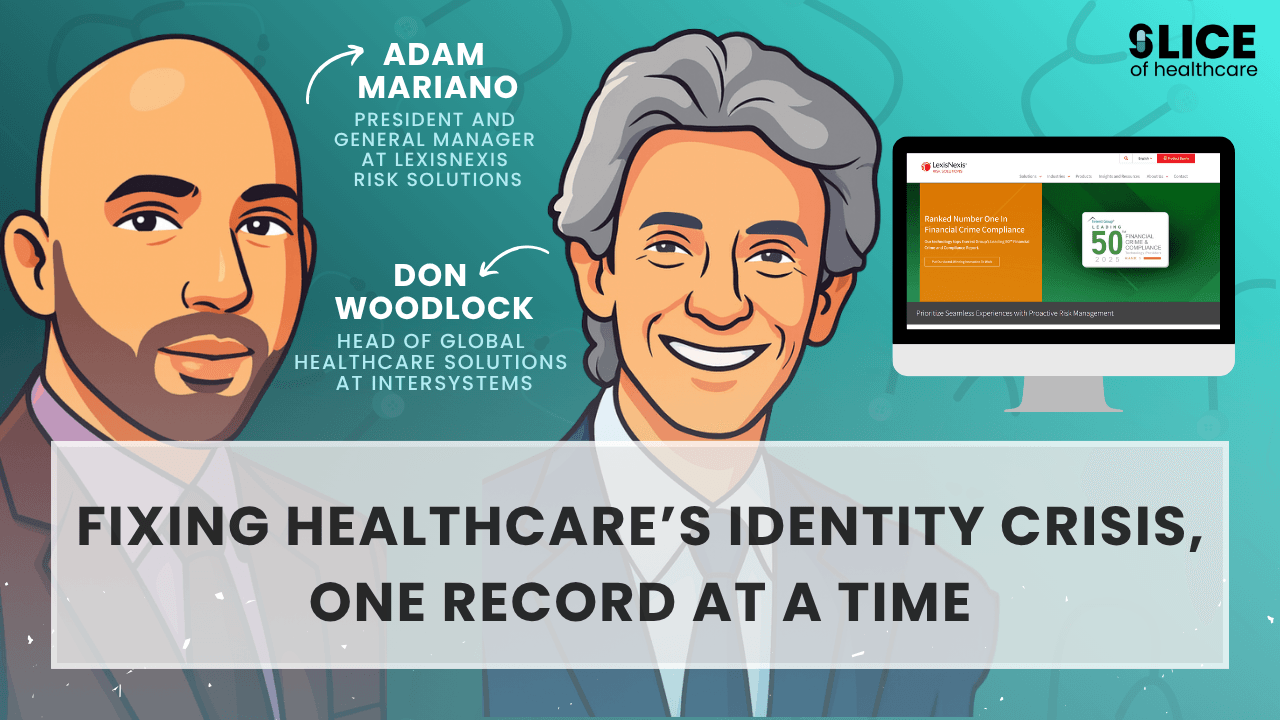
Adam Mariano started his career at the bedside as a nurse. That clinical lens never left, even as he moved into IT, software development, analytics, and now leads the healthcare division at LexisNexis Risk Solutions. “Over the years,” he said, “I’ve worked with organizations across the full healthcare ecosystem to drive better care through data.”
Don Woodlock, now head of global healthcare solutions at InterSystems, has been building healthcare software for over 30 years, from clinics to global data platforms. His current mission? Make healthcare data move safely, accurately, and at scale.
Why It Stands Out
The U.S. healthcare system wasn’t required to go digital until 2012. “So we’re dealing with 50 years of modern healthcare on paper,” Mariano noted. Even now, much of the digitization effort focused on billing, not care. “EMRs were built for claims, not treatment,” he added. Different systems speak different languages and don’t understand each other.
And even when data is digitized, it often can’t be trusted. Why? Because records describing the same person often don’t match. “Every silo describes you differently,” Woodlock explained. “Different name, address, medical record number—it’s the first and biggest barrier.”
Together, InterSystems and LexisNexis are solving that root problem by combining referential data and matching algorithms. “We can crank up match rates well beyond what simple demographic matching could do,” said Woodlock.
A Customer Story
No specific organization was named, but the impact is felt in countless patient interactions. For example: someone shows up at an ER, but their medication list doesn’t come with them. If they’re elderly or have multiple chronic conditions, that missing information can be dangerous or even fatal. “I've watched this in my family,” Mariano said. “You can cause catastrophic damage without a full record.”
Who It Helps
Patients, first and foremost. Especially those navigating chronic conditions, multiple doctors, or transitioning from one life stage to another. “There’s nothing worse than having to fill out the same form over and over in digital form, even within the same health system,” Mariano said. “It’s where you lose compliance and trust.”
Clinicians, payers, and digital health innovators also benefit. Anyone trying to make decisions or deliver care based on accurate, complete data. And as shared-risk models become more common in public programs, the need for trusted data only grows.
Where It’s Going
The partnership is pushing toward a healthcare system where identity is foundational, not an afterthought. That means resolving not just “who is this?” but “what do they need?” With expanded datasets and enriched profiles, the goal is to deliver smarter engagement, more equitable care, and fewer dangerous gaps.
Conclusion
We’ve solved harder problems in other industries. What’s held healthcare back isn’t lack of technology. It’s a lack of alignment. But as LexisNexis and InterSystems show, collaboration rooted in identity-first thinking might finally be the breakthrough patients have been waiting for.
Expert Insights
Share Your Expert Insights
Have relevant experience or professional perspective? Add your thoughtful insights to this article.