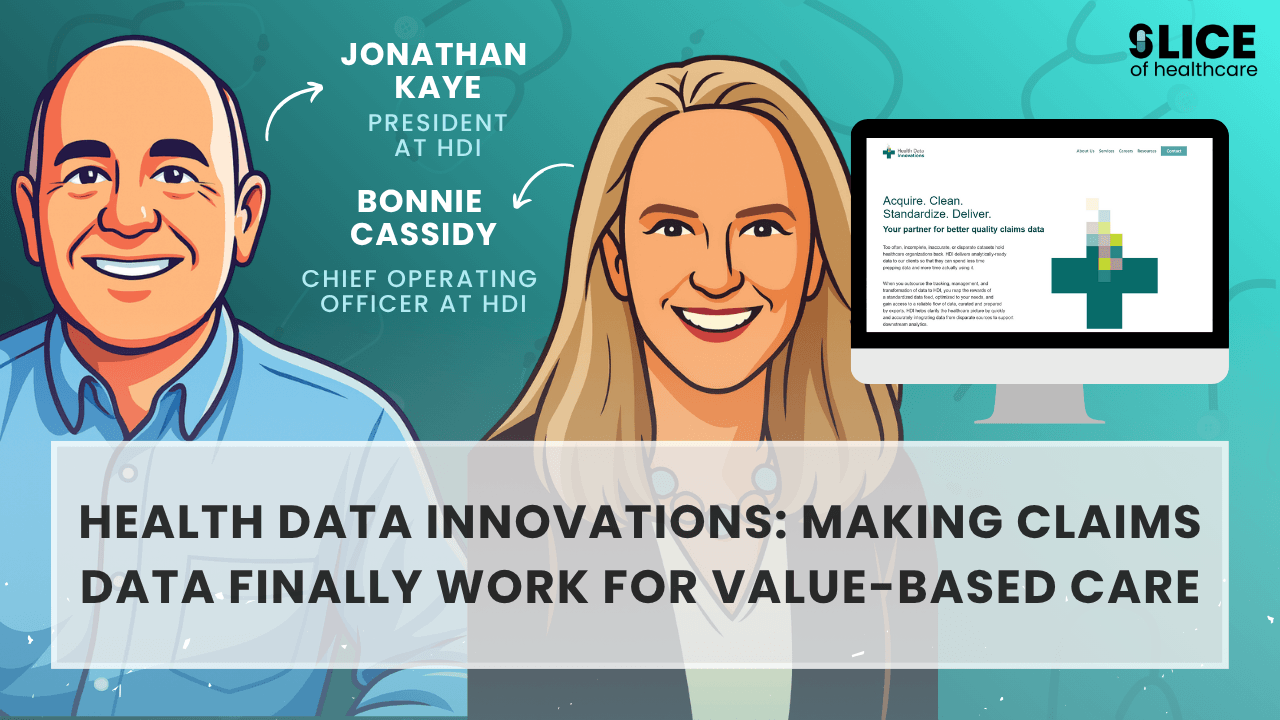
Health Data Innovations: Making Claims Data Finally Work for Value-Based Care

Slice of Healthcare Team
08/19/2025


Introduction
The healthcare system might be fragmented, but your data doesn’t have to be. That’s the message Jonathan Kaye and Bonnie Cassidy want every provider, payer, and partner to hear. As leaders at Health Data Innovations (HDI), they’ve built a company around one deceptively difficult mission: make claims data usable and useful for organizations moving toward value-based care.
What HDI Does
Health Data Innovations helps healthcare organizations integrate and standardize claims data from multiple sources. They turn messy, inconsistent data into a clean, common framework that supports analytics, reporting, and care management, regardless of whether the data came from Aetna, CMS, or Blue Cross.
In short: they take the headache out of healthcare data ingestion so providers and payers can actually use their data.
How It All Started
The idea for HDI started with a problem. One major Blue Cross plan couldn’t get new employer groups onboarded fast enough to do meaningful care management. They were losing money because they couldn’t use the data.
They called Jonathan Kaye, who’d previously built a company called HDMS (sold to Active Health and then Aetna). Could he help? He pulled together a team of experts, many from HDMS, and got to work. The goal wasn’t just to clean data for one client, but to create a service any organization could use to integrate claims data, no matter the source or destination.
Why It Stands Out
Most healthcare organizations are good at managing their own data. But bring in external claims data from dozens of payers? That’s a different story.
What makes HDI unique is that they’ve built a system that treats all that data—medical, Rx, eligibility, attribution—as part of one understandable whole. They standardize everything from formats to financials to utilization metrics so their clients don’t have to juggle ten different definitions of “readmission.”
As Kaye puts it, “You want to do analytics independent of the source.” That’s what HDI enables.
A Customer Story
While client names weren’t mentioned in the podcast, one example stood out: Epic, the electronic health record giant, regularly refers customers to HDI. According to Cassidy, when clients ask for references, she often responds, “Other than Epic?” It’s a vote of confidence that speaks volumes.
They’ve also built a following among repeat customers—people who change jobs and bring HDI with them to their new companies. “They know how hard this is,” says Kaye. “And they say, ‘Call these guys.’”
Who It Helps
HDI works with providers, payers, and health systems—anyone managing risk-based contracts or trying to get a full picture of patient care. That includes those using tools like Epic, Arcadia, Tuva, or Milliman. Increasingly, HDI acts as a central data hub, taking in data once and sending it out to multiple platforms, saving clients from redundant integrations and validations.
Expert Insights
Share Your Expert Insights
Have relevant experience or professional perspective? Add your thoughtful insights to this article.