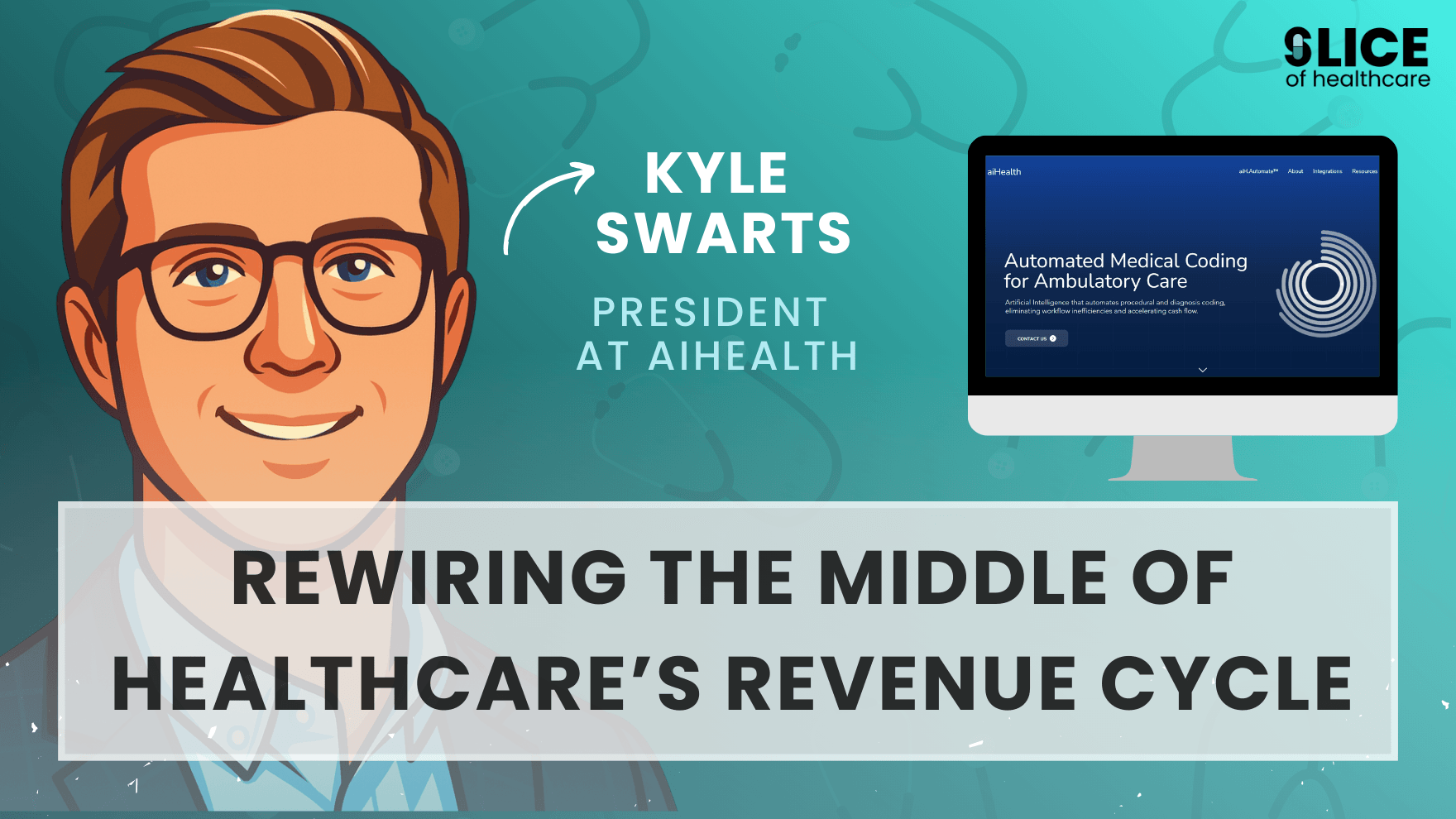
Rewiring the Middle of Healthcare’s Revenue Cycle

Slice of Healthcare Team
10/16/2025


Introduction
When Kyle Swarts talks about medical coding, he doesn’t reach for buzzwords or lofty promises. He talks about broken workflows, faxes, and the sheer volume of humans required to get one claim coded. It’s not flashy, but it’s real. And it’s exactly what aiHealth was built to fix.
A Smarter, Saner Way to Do Medical Coding
aiHealth is an autonomous medical coding platform focused on the outpatient specialty market. Their platform handles everything from scanned PDFs and e-faxes to E&M procedural and diagnostic coding. The goal? Replace repetitive manual work with automation that actually fits into the messy, real-world workflows of providers.
From Consulting to Coding: How aiHealth Started
Before launching aiHealth, Swarts spent years in healthcare consulting and IT. He saw firsthand how bloated and inefficient the middle of the revenue cycle had become, especially in medical coding. “There were just too many humans involved,” he said. “It was all brute force.” So he and his team set out to do something different: automate the parts of coding that should have been automated years ago.
What Makes It Different
Swarts is blunt about what aiHealth is and isn’t. It’s not a magic bullet. It won’t fix a broken workflow unless the client is willing to change it. That’s where aiHealth’s consultative approach comes in: helping organizations rethink outdated processes, not just throw AI at them.
They’ve also tackled one of the biggest hidden hurdles in healthcare tech: outdated business associate agreements. Many clients are still operating under 20-year-old contracts that don’t account for modern data use or AI. aiHealth works early in the sales process to educate clients, update these agreements, and clear the way for meaningful automation.
Why Outpatient? Follow the Migration
aiHealth chose to focus on ambulatory care for a reason: that’s where the action is. Procedures once done in hospitals like orthopedics, ENT, gastro, and urology are moving to surgery centers. But the tech hasn’t followed. While inpatient tools have advanced, outpatient practices are left cobbling together outdated systems. aiHealth is changing that, one specialty at a time.
Who It Helps
Specialty outpatient providers dealing with complex, unstructured documents are the sweet spot. These are often practices with limited modern tools, stuck in outdated workflows, and overwhelmed by staffing shortages. aiHealth offers them a way out — automation that works with what they have and scales as they grow.
What’s Next
Looking ahead, aiHealth is expanding its product capabilities. Auditing and clinical documentation improvement are top priorities. There’s also interest in offering end-to-end platforms for ambulatory revenue cycle management. And as AI continues to evolve, Swarts is keeping his team sharp. “We allocate a vast majority of our team’s time towards research,” he said. “We need to be at the forefront.”
Expert Insights
Share Your Expert Insights
Have relevant experience or professional perspective? Add your thoughtful insights to this article.